

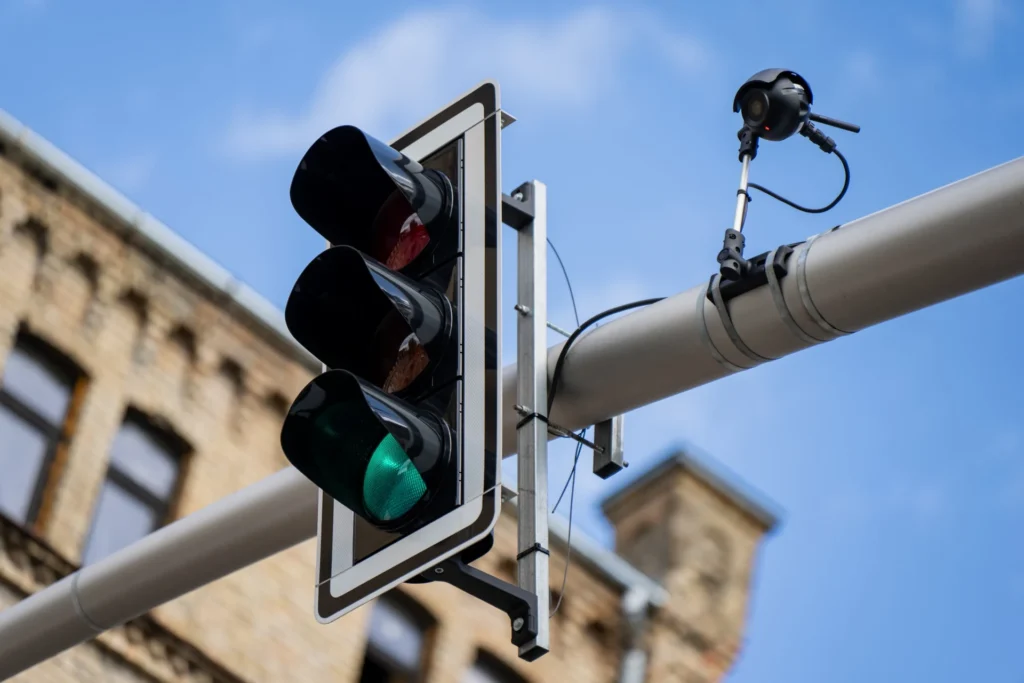
Intelligent traffic systems (ITS) are the detectors, signals, signs, cameras and communications networks that let road operators see what traffic is doing and respond in real time. In Australia they are now designed into major road projects from day one, from motorway tunnels to suburban intersections, and the part most people never see is the civil and cabling work underneath.
Australia also had a head start. SCATS, the adaptive traffic control system the NSW Government established in the mid-1970s, has been installed at more than 60,000 intersections across 200 cities and 30 countries. SCATS reports reductions of 28% in travel time, 25% in stops, 12% in fuel use and 15% in emissions. Not bad for a system that started out managing Sydney’s traffic lights.
Where intelligent traffic systems fit in a road project
ITS is no longer a separate package added once the asphalt is down. On modern projects it shapes the civil design: where pits and conduits go, how cabinets are powered, and how every device talks back to a control centre. That is the side of intelligent traffic systems work BRP Industries focuses on.
Our earlier post on road safety technology in intelligent traffic systems runs through the individual technologies. This one looks at the projects themselves, which tend to fall into three scales.
Motorways and tunnels
On a motorway, ITS is the nervous system. Vehicle detection, variable message signs, lane control, CCTV and incident management run around the clock, linked by fibre to a control centre that can change a speed limit or close a lane in moments.
BRP has installed ITS infrastructure on NorthConnex and WestConnex, two of the largest transport projects in NSW. Work at that scale is about volume and coordination: long conduit runs, pits and cabinets at regular intervals, and communications that have to work the first time the control centre switches them on.
Urban intersections and arterial roads
Most Australians meet ITS at a set of traffic lights. Adaptive systems such as SCATS adjust signal timing to the traffic actually present, and they depend on detection at each approach. At many intersections that still means inductive loops cut into the pavement near the stop line, wired back to the controller in the roadside cabinet.
Loops are simple, durable and unglamorous, and they are a specialty in their own right. BRP has deliberately built a team of specialist employees so it can be self-sufficient in ITS and traffic loop work. Loops sit where civil and electrical work overlap: they are cut into the road surface, so resurfacing has to be sequenced around them, or the new asphalt goes down and the detection disappears underneath it.
Connected vehicles and roadside stations
The next layer is cooperative ITS, or C-ITS, where vehicles and roadside equipment exchange messages directly. Queensland’s Ipswich Connected Vehicle Pilot was Australia’s largest C-ITS field test: 355 public participants had their vehicles fitted with connected vehicle technology, working with 29 roadside stations and a central station across a 300 square kilometre pilot area for 12 months. The pilot used vehicle-to-infrastructure communication to give drivers safety warnings.
For contractors, the takeaway is practical. A roadside station is one more device that needs a footing, power and a reliable communications path, which is exactly the work intersection and motorway ITS already involves.
What actually gets built under a smart intersection
Take a typical signalised intersection upgrade with new detection, cameras and a fibre connection back to the network. The visible result is a few poles and a cabinet. The work that gets it there runs roughly in this order.
First, existing services are located and proven. Intersections are crowded underground, with power, water, gas and telecommunications often sharing the same corridor, so crews use service location and non-destructive vacuum excavation to expose assets before anything heavier goes in.
Next come the conduits and pits. Where open trenching would close live lanes, directional drilling and trenchless technology can put conduit under the road while traffic keeps moving above it.
Then come cabinet footings, power supply and loop cutting, followed by the cable hauling, fibre splicing and terminations that connect every device. Commissioning with the road authority comes last, and it only goes smoothly when the as-built records match what is actually in the ground.
Traffic management sits over the whole job. Much of this work happens at night or in short possession windows, so staging matters as much as the engineering.
Why the workload is growing
Transport remains the largest share of Australia’s public infrastructure spending. Infrastructure Australia’s 2025 Infrastructure Market Capacity Report puts transport investment at $129 billion, or 53% of the $242 billion five-year Major Public Infrastructure Pipeline. Most new road projects in that pipeline carry some ITS scope, whether it is a motorway control system or a handful of upgraded intersections.
Bring the ITS contractor in with the civil staging
The most useful decision a project team can make about ITS is when to involve the people who will install it. Pit locations, conduit routes, cabinet positions and resurfacing sequences are all set during civil design and staging, and moving them later costs time on a live road.
BRP Industries delivers ITS installation alongside directional drilling, trenching and non-destructive excavation, so the civil and ITS scopes are planned by one team. For projects in NSW, the ACT or South East Queensland, get in touch with BRP Industries to talk through staging, or call 0431 151 131.