

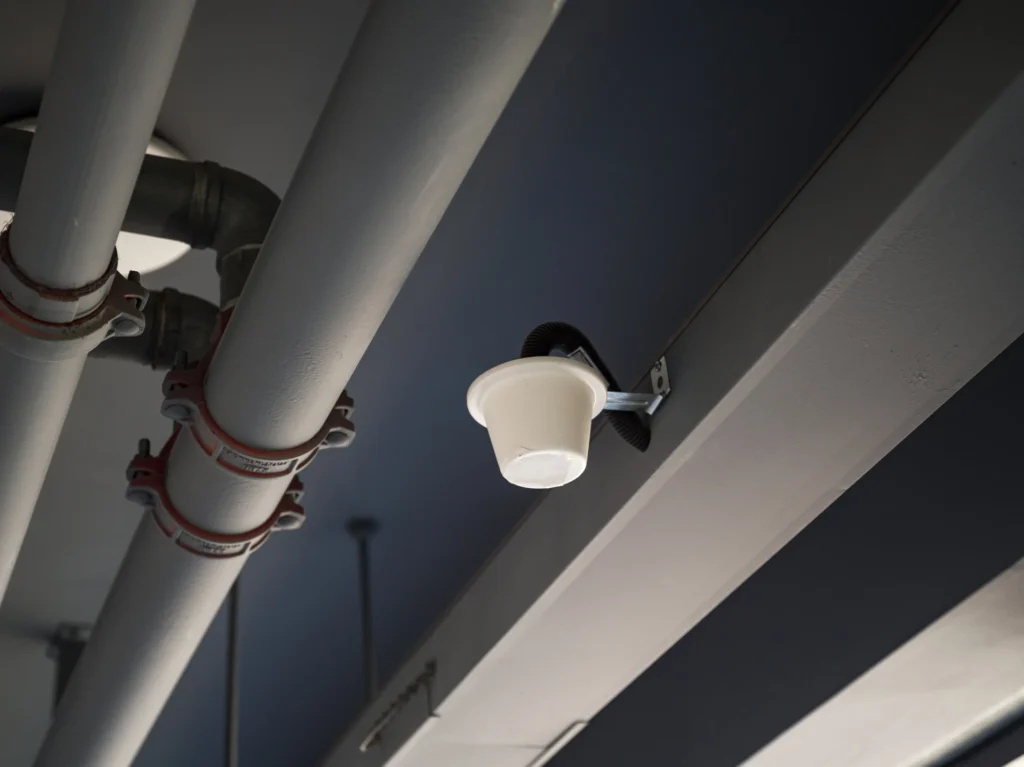
A distributed antenna system (DAS) is a network of small antennas spread through a building or site, fed by cabling from a central point where the mobile carriers connect their equipment. It exists so phones work indoors in places the nearest tower cannot reach. 5G has made that job harder, because the higher-frequency bands carriers now rely on lose more strength passing through concrete, steel and coated glass.
Most people only discover a building has a DAS when it stops working. Here is what sits above the ceiling tiles, what 5G has changed, and what to sort out before the plasterers arrive.
What a distributed antenna system actually does
Mobile towers are designed to cover streets and suburbs. They are not designed for basements, car parks, plant rooms, hospital wards or the middle of a deep floor plate wrapped in energy-efficient glazing. Modern buildings are very good at keeping the weather out, and the same materials do a fine job of keeping mobile signal out too.
A DAS brings the network inside. Instead of one large antenna trying to push signal through the walls, many small antennas each cover a modest area at low power, all connected back to the carriers’ equipment. Done well, nobody notices it. The antennas are small discs or panels on the ceiling, and the only visible result is that calls stop dropping in the lift lobby.
Following the signal from the comms room to level 14
The easiest way to understand a DAS, and what you are paying for, is to follow the signal through the building.
The head-end
Each carrier connects its radio equipment to the system, usually in a dedicated comms room. This is where the outdoor network hands over to the in-building one.
The backbone
From the head-end, the signal travels up the building through the risers. On larger sites this is usually fibre, which carries signal over long distances with minimal loss and does not pick up interference from nearby power or electromagnetic sources.
The floor distribution
On each floor, coaxial cable or powered remote units carry the signal through the ceiling space to the antennas. This is where most of the cable metres, and most of the labour, end up.
The antennas
Antennas are placed so their coverage overlaps without leaving gaps, and without leaking so much signal outside that it interferes with the carriers’ outdoor network.
Every one of those stages is physical work: cable hauled through risers, fibre spliced, antennas mounted, every run labelled and tested. The radio design gets the attention, but the cabling is what the building lives with for years. That cable work is the core of BRP’s distributed antenna systems and cable hauling service.
Passive, active or hybrid: which suits which building?
There are three broad ways to build a DAS, and the right one depends mostly on the size of the site.
A passive DAS uses coaxial cable, splitters and couplers, with no powered equipment out on the floors. It is simple and has little to maintain, but signal weakens over every metre of coax, so it suits small and mid-sized buildings.
An active DAS converts the signal for transport over fibre to powered remote units near the antennas. It handles large buildings, campuses, stadiums and tunnels, at the cost of more equipment that needs power, space and maintenance.
A hybrid DAS runs a fibre backbone up the risers and passive coax across each floor. It is a common middle ground for mid-rise and high-rise commercial buildings.
Why 5G has raised the bar for in-building coverage
5G gives carriers more capacity, much of it in higher-frequency spectrum. Higher frequencies carry more data but travel shorter distances and lose more strength through building materials. A site with passable 4G indoors can find its 5G coverage patchy or missing altogether.
The industry guidance has moved as well. The Australian Mobile Telecommunications Association’s in-building coverage guidance now points building owners to the 2025 Design Guidelines for Distributed Antenna Systems. The guidelines were developed to cater for 5G technology and new spectrum bands, and they drop the old 3G requirements because Australia’s 3G networks have closed. AMTA’s message to owners is that a DAS built to the guidelines is one the carriers can confidently connect to.
If your building’s DAS was designed around older guidance, the useful question is a specific one: can it carry the bands the carriers use now? The answer may be that the fibre backbone and cable pathways can be reused while some components cannot. That is a question for a site survey, not a guess.
One system, three carriers
In Australia, an in-building system normally needs to serve Telstra, Optus and TPG Telecom. Each carrier has its own in-building team and approves the components that connect to its network, and AMTA’s page lists the carrier contacts and approved material lists. Some buildings instead use a DAS infrastructure operator, which builds and runs a shared system that the carriers connect to.
Either way, the carriers want to see the design before installation, not after. Bringing them in late is an easy way for a DAS project to lose months.
The best time to install a DAS is before the ceilings go in
A DAS can be retrofitted, but it is slower and dearer once tenants are in. Crews work after hours, ceilings come down and go back up, and cable routes have to find their way around services that are already there.
Installing during construction is far simpler. BRP Industries was involved from the start of construction on the Crown casino at Barangaroo, installing the mobile DAS and in-building coverage throughout the building for the Optus network. Starting early meant pathways, risers and comms rooms could be planned with the DAS in mind rather than squeezed in later.
A DAS is not only an indoor technology either. BRP was commissioned by the Gold Coast council to help deliver mobile DAS installations in public beachfront areas, using civil crews and horizontal directional drilling on the Gold Coast to run cabling with less disruption to busy public spaces.
What to have ready before the first conversation
A useful first meeting needs only a few things: floor plans, riser and comms room locations, the areas that matter most (car parks and lift lobbies are frequent offenders), and whether any carrier or DAS operator is already involved. From there, a survey of the existing cabling pathways tells you whether you are looking at a new build-out, an upgrade or a fairly modest fix.
BRP starts every DAS job by surveying the existing site infrastructure, then handles cabling design, installation, splicing and maintenance. That includes DAS and data cabling in Canberra, and the same capability sits behind BRP’s data cabling solutions in Sydney.
If you are planning a new building, or wondering whether an existing system will keep up with 5G, talk to BRP Industries or call 0431 151 131.