

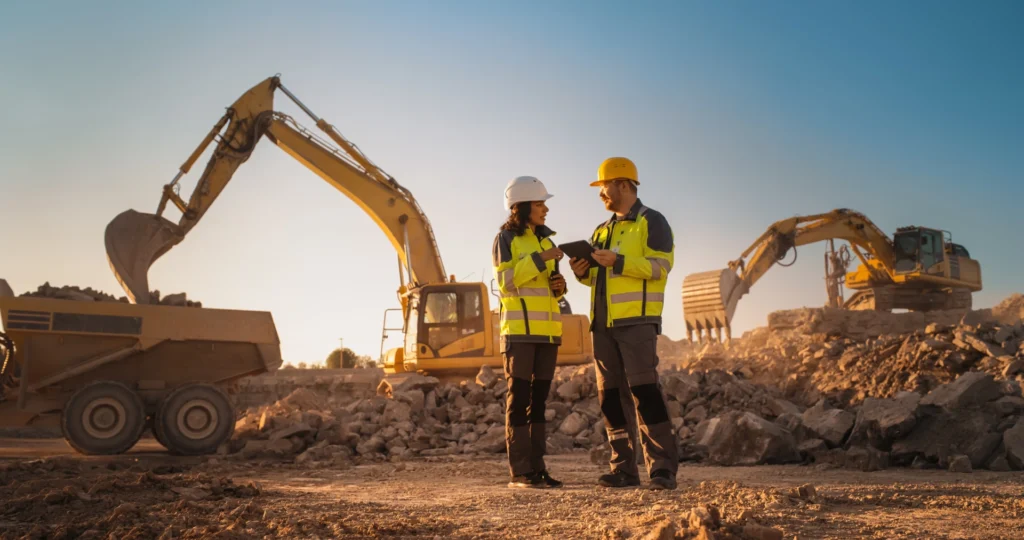
Civil construction in 2026 looks increasingly different from the industry of even five years ago.
Digital planning, smarter machinery, lower-impact excavation and more rigorous sustainability expectations are changing how infrastructure is designed and delivered. For contractors, councils and project managers, understanding these shifts is becoming part of everyday project planning.
Here are the major civil construction trends in 2026, from technology adoption to more sustainable ways of working.
What is changing in civil construction in 2026?
Civil construction is becoming more connected, data-driven and environmentally conscious.
Projects still depend on skilled people, reliable machinery and sound engineering, but the way those elements come together is changing. Digital project controls, improved underground construction methods, environmental targets and better site data are allowing teams to make decisions earlier and reduce unnecessary disruption.
These changes are particularly visible across large infrastructure programmes and specialised civil construction work in Sydney, where dense existing infrastructure makes planning, coordination and site efficiency increasingly important.
1. Digital planning is becoming part of everyday construction
Digital tools have steadily moved from being a useful addition to becoming part of normal project delivery.
Building information modelling, geographic information systems, cloud-based project platforms and digital site records can help teams understand conditions before work starts.
The practical benefits are fairly straightforward.
Project managers can access current drawings instead of relying on outdated versions. Site teams can record progress digitally. Engineers can review information without waiting for paperwork to travel between offices.
Digital records also make communication easier when several contractors are working on the same project.
Australia’s broader infrastructure pipeline reinforces the importance of stronger planning and project coordination. Infrastructure Australia provides research and guidance around infrastructure needs, planning and investment across the country.
Technology does not remove project risk, of course. A fancy dashboard cannot fix poor planning. What it can do is make good planning easier to maintain.
2. Underground construction is becoming more precise
One of the less glamorous realities of civil construction is that there is already a lot underneath our feet.
Water mains, telecommunications, electrical networks, gas services and drainage infrastructure can all complicate new works.
That is encouraging greater use of construction methods that minimise surface disturbance.
For example, horizontal directional drilling on the Gold Coast can allow pipes or conduits to be installed beneath roads, landscaped areas and other obstacles without opening a continuous trench.
It is particularly useful where traditional excavation would create unnecessary traffic disruption or damage to finished surfaces.
Non-destructive digging techniques are also playing a bigger role. Where underground assets must be exposed before excavation proceeds, vacuum excavation in Newcastle provides a controlled way to remove soil around sensitive services.
The trend is not simply towards digging faster. It is towards knowing what is underground and disturbing as little of it as possible.
3. Sustainability is moving from aspiration to project requirement
Sustainability in civil construction is no longer confined to recycling bins in the site office.
Infrastructure clients are paying closer attention to material consumption, emissions, waste, vegetation disturbance and the full environmental footprint of construction.
That is influencing decisions at several stages.
| Construction consideration | Traditional focus | Growing 2026 focus |
| Excavation | Speed and access | Reduced disturbance and spoil |
| Materials | Upfront cost | Durability, recycled content and lifecycle impact |
| Machinery | Productivity | Productivity plus fuel and emissions performance |
| Project design | Buildability | Buildability plus environmental impact |
| Site records | Compliance documentation | Data for compliance and sustainability reporting |
Australian environmental policy also continues to influence how infrastructure owners consider emissions and environmental performance. The Australian Government’s Department of Climate Change, Energy, the Environment and Water provides national information relating to climate, energy and environmental policy.
For contractors, sustainability increasingly comes down to practical decisions rather than slogans.
Using a trenchless installation method where suitable, reducing unnecessary spoil removal or avoiding repeated excavation can all contribute to a smaller site footprint.
4. Civil construction is becoming more location-specific
Infrastructure challenges vary considerably between regions.
A dense metropolitan road corridor may contain decades of buried utilities. A growing outer suburb may require new communications, water or electrical infrastructure. Regional projects may have more room to operate but face different logistical constraints.
That makes local project knowledge increasingly useful.
For example, the requirements surrounding civil construction projects in Canberra may differ significantly from those affecting civil construction solutions in Brisbane.
The underlying engineering principles remain the same, but access conditions, utility density, ground conditions, environmental controls and traffic management can vary.
In 2026, successful project planning increasingly means accounting for those conditions early rather than treating them as problems to solve once machinery arrives.
5. Better utility information is reducing avoidable risk
Subsurface information has historically been one of the more uncertain parts of construction planning.
A drawing might show where a service was supposed to be installed decades ago, but the real-world location can be another story entirely.
Modern projects increasingly combine several sources of information.
These may include:
- Existing utility records: Historical plans provide an initial understanding of likely service locations.
- Electronic locating equipment: Detection technology can help identify conductive services before excavation.
- Non-destructive excavation: Small exposure points can physically confirm the location and depth of underground assets.
- Digital survey records: Verified information can be recorded for future construction and maintenance work.
Taken together, these methods give construction teams a clearer picture of what they are dealing with.
That matters because underground uncertainty has consequences. Unexpected utilities can affect schedules, redesign requirements, workforce safety and surrounding infrastructure.
Better information is rarely the most exciting part of a civil project, but neither is accidentally finding a water main with an excavator.
6. Skills are changing alongside machinery
Automation and digital tools often trigger predictions that construction jobs will become increasingly automated.
The reality is more nuanced.
Technology is changing what workers need to understand, but civil construction still depends heavily on judgement, experience and site awareness.
Operators increasingly work with digital plans, locating data and machine controls. Supervisors may need to manage information flowing between site and office systems. Project managers are expected to interpret larger amounts of data while still understanding practical construction constraints.
Companies working across specialised infrastructure disciplines, such as BRP Industries, increasingly operate at the intersection of physical construction and technical coordination.
That combination is likely to become more important as projects become more complex.
7. Efficiency increasingly means reducing rework
Construction efficiency used to be discussed largely in terms of getting work completed quickly.
Speed still matters, but rework is receiving much more attention.
Incorrect excavation, damaged utilities, outdated drawings, design conflicts and poorly coordinated contractors can all result in work being repeated.
That costs time and materials and can create additional environmental impact.
Digital project controls, underground locating, accurate surveying and careful sequencing all contribute to reducing those problems.
The most efficient construction process is often not the one that moves fastest on day one. It is the one that reaches completion without repeatedly undoing yesterday’s work.
Where civil construction is heading next
The defining civil construction trends in 2026 are closely connected.
Digital technology improves visibility. Better visibility supports safer excavation and stronger project coordination. More precise construction methods can reduce unnecessary disturbance. Reduced disturbance can support environmental and cost objectives at the same time.
None of these developments makes traditional construction knowledge obsolete.
If anything, the opposite is true.
Technology works best when it supports experienced decision-making, careful planning and appropriate construction methods. As infrastructure projects become more complex, contractors that can combine those elements will be better equipped to deal with the practical realities of modern civil construction.